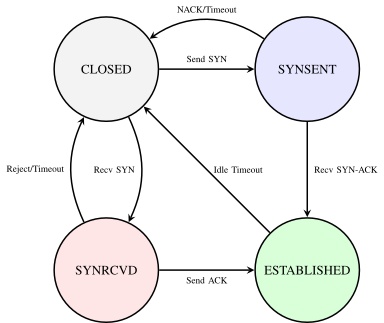
 (a) Connection Session Lifecycle FSM (Stateful vs. Stateless)
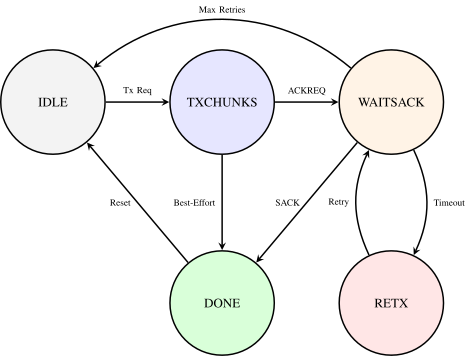 (b) Data Transfer & SACK-ARQ FSM (Reliable vs. Unreliable)
Abstract
This supplementary document provides extended implementation details, architectural state machines, and secondary parametric simulation blocks supporting the main manuscript “LAMP: A Selective-ACK Transport Protocol for Reliable Bulk Data Transmission over LoRa Networks”. Specifically, we document: (i) the preliminary commercial transceiver proof-of-concept and its architectural lessons; (ii) the detailed Hardware Abstraction Layer (HAL) architecture on ESP32-S3 and desktop Unity test harness; (iii) formal finite state machine specifications for session lifecycle and data transfer; and (iv) extended ns-3 simulation studies evaluating message size scaling up to 62.2 kB (Block F), asymmetric acknowledgment loss sensitivity (Block G), retransmission poll rule ablation (Block H), and additional propagation channel profiles (Rural, Water, Static).
Index Terms
LoRa, SACK, transport protocol, embedded systems, HAL, state machines, sensitivity analysis.
Prior to developing the native C++17 LAMP stack on Semtech SX1262 transceivers, an initial proof-of-concept was developed and evaluated using commercial Ebyte E220-series LoRa modules. These modules encapsulate physical-layer modulation behind an internal microcontroller running proprietary AT-command firmware accessible over an asynchronous UART interface.
While initial lab tests confirmed the basic feasibility of transport fragmentation over LoRa physical links, the trial exposed three critical architectural bottlenecks that motivated the ground-up redesign of LAMP:
These empirical findings motivated the complete transition to the open-source Semtech SX126x architecture driven via RadioLib and decoupled by a clean Hardware Abstraction Layer (HAL).
To eliminate hardcoded constants and enable deterministic tuning across heterogeneous embedded targets, all protocol operational parameters are centralized within a compile-time configuration namespace (LoRaMultiPacketConfig):
The core transport logic communicates exclusively through abstract interfaces (IRadio and IPlatform). On physical nodes, EspHal wraps ESP32-S3 hardware resources:
Following a test-driven development (TDD) discipline, the protocol core is verified on a desktop host environment using the Unity test framework within PlatformIO (72 native unit tests), executing without hardware-in-the-loop dependencies:
Fig. 1 details the formal finite state machines governing the connection lifecycle and data transfer engines within LAMP.
(a) Connection Session Lifecycle FSM (Stateful vs. Stateless)
(b) Data Transfer & SACK-ARQ FSM (Reliable vs. Unreliable)
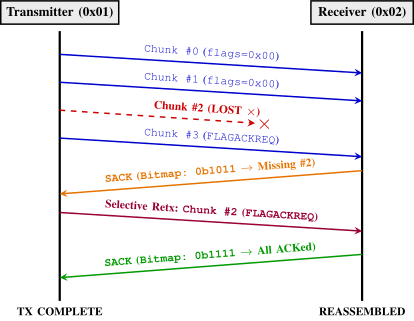
Fig. 2 and Fig. 3 illustrate the detailed message interaction flows for connection establishment, rejection handling, and SACK-ARQ selective repair.
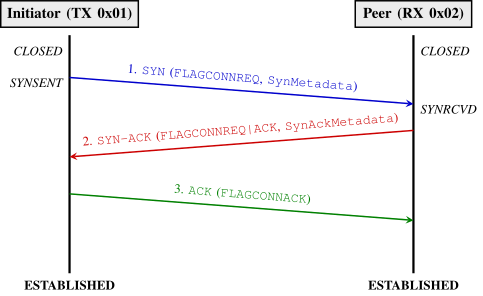 (a) Successful 3-Way Handshake (3WHS) with Metadata Negotiation
 (b) Connection Rejection (CONN_NACK) Failure Mode
Algorithm 1 details the receiver-side out-of-order reassembly, CRC verification, and SACK bitmap generation logic, while Algorithm 2 formalizes the transmitter-side segmentation, burst dispatch, and selective repair loop.
Table I details representative timeout parameters across spreading factors (BW 125 kHz, CR 4/5).
| SF | \(\widehat {T}_{\mathrm {DATA}}\) (ms) | \(\widehat {T}_{\mathrm {SACK}}\) (ms) | \(\alpha (\widehat {T}_{\mathrm {DATA}}+\widehat {T}_{\mathrm {SACK}})+\delta \) (ms) | \(T_{\mathrm {timeout}}\) (ms) |
| 7 | 400 | 46 | 719 | 1000 |
| 8 | 707 | 82 | 1234 | 1234 |
| 9 | 1250 | 165 | 2173 | 2173 |
| 10 | 2296 | 289 | 3927 | 3927 |
| 11 | 5001 | 660 | 8541 | 8541 |
| 12 | 9019 | 1155 | 15312 | 15312 |
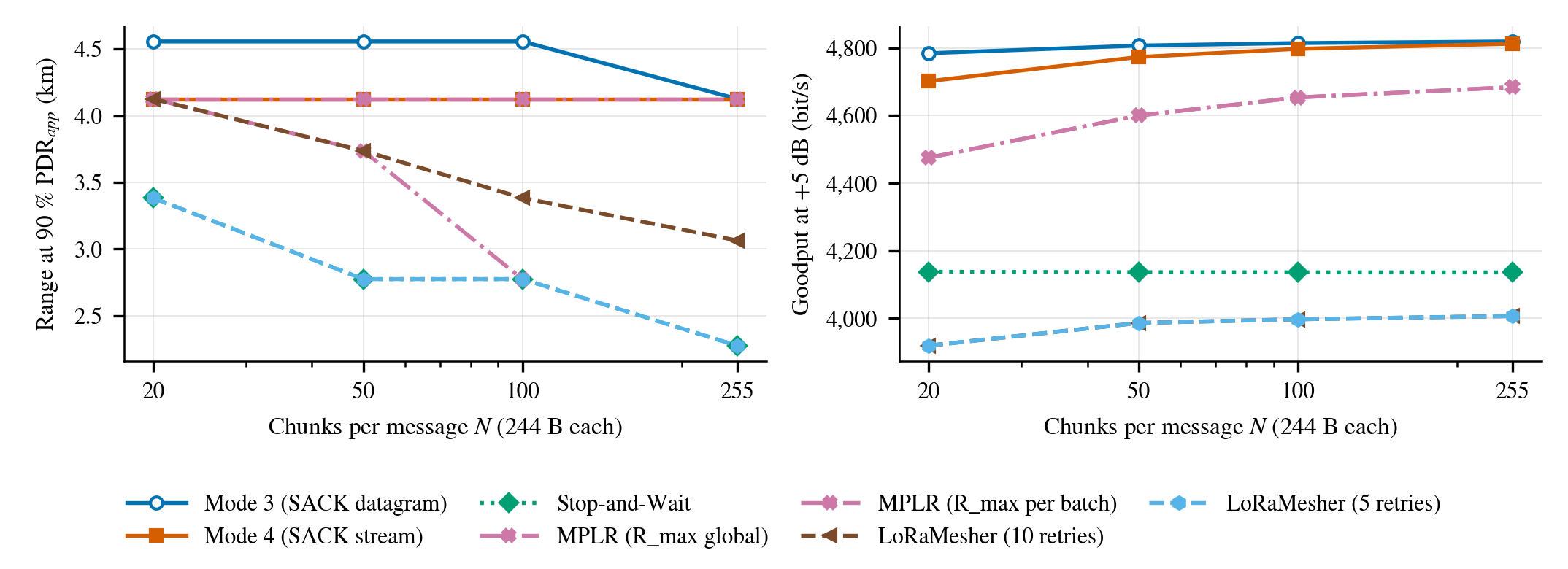
Block F evaluates protocol performance under large payload scaling at SF7 across message sizes \(N \in \{20, 50, 100, 255\}\) chunks of 244 B (4.9 to 62.2 kB, reaching the maximum capacity of a single LAMP session). Comparative baselines include Stop-and-Wait, MPLR [1], and LoRaMesher [2].
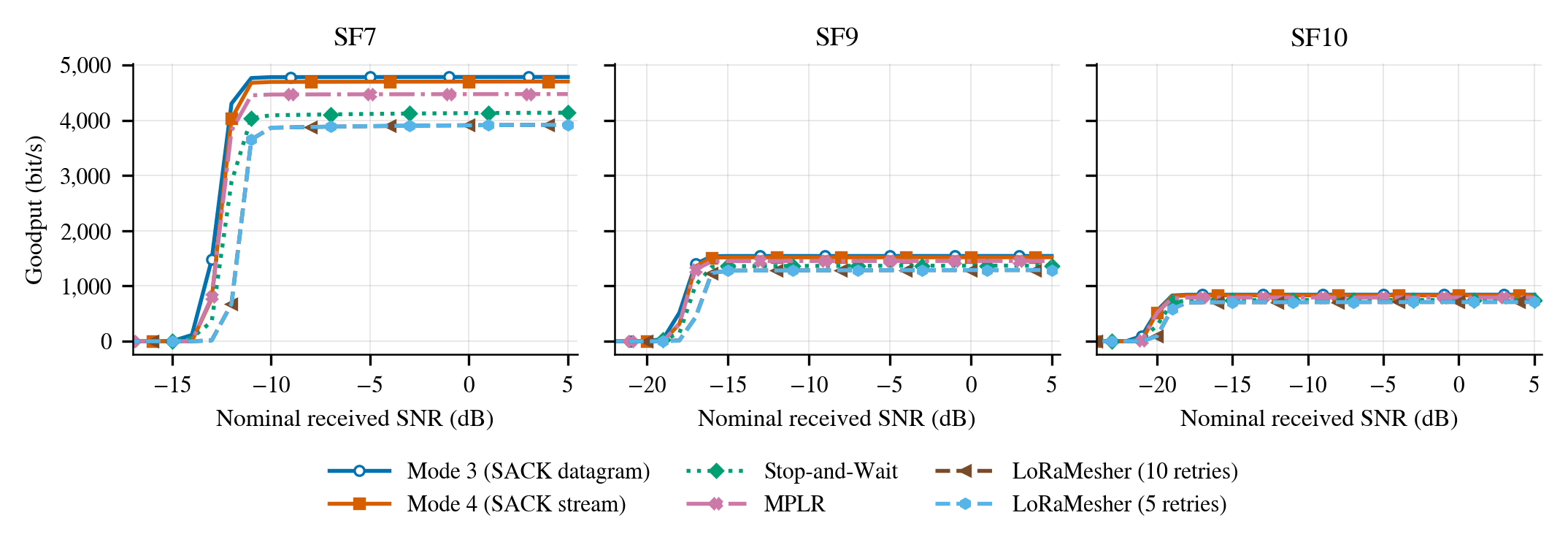
Fig. 4 depicts the 90% PDR delivery range in the Urban channel and goodput under static lossless conditions. The delivery range of LAMP remains invariant to message size (Mode 4 maintains 4.13 km; Mode 3 maintains 4.56 km up to 100 chunks and 4.13 km at 255 chunks). Conversely, architectures assigning individual per-frame retry budgets experience compounding degradation as \(N\) increases: Stop-and-Wait drops from 3.38 km to 2.26 km, while LoRaMesher (\(R=10\)) falls from 4.13 km to 3.09 km.
For MPLR, behavior depends on the interpretation of its retry budget: if \(R_{\mathrm {max}}\) applies globally across the entire multi-batch transfer, range collapses to 3.7 km at \(N=50\) and fails to reach 90% at \(N=255\). If \(R_{\mathrm {max}}\) is refreshed per batch of 40 frames, MPLR maintains 4.13 km, matching Mode 4. Under this favorable reading, LAMP retains higher goodput due to its compact 9-byte header (+3% faster at 62.2 kB, delivering in 103 s vs. 106 s).
Block G investigates performance when feedback frames (SACK, SYN-ACK, ACK) are subjected to loss probability \(p_{\mathrm {ack}} \in \{0, 20, 40\}\%\), concurrent with data frame loss \(p \in [0, 50]\%\) (SF7, \(N=20\)).
Because lost SACK feedback triggers the timer-driven poll mechanism, the penalty is predominantly manifested as latency rather than transfer aborts. At \(p=20\%\) and \(p_{\mathrm {ack}}=20\%\), Mode 3 maintains 98% transfer completion, with elapsed time increasing moderately from 11.1 s to 11.7 s; at \(p_{\mathrm {ack}}=40\%\), completion remains at 92% (13.1 s). In Mode 4, lost SYN-ACK frames incur handshake retries, increasing latency to 15.8 s at \(p=20\%, p_{\mathrm {ack}}=40\%\).
In contrast, Stop-and-Wait exhibits severe sensitivity to feedback losses: at \(p=30\%\), its completion rate plunges from 100% (lossless feedback) down to 84% at \(p_{\mathrm {ack}}=20\%\) and 46% at \(p_{\mathrm {ack}}=40\%\), whereas LAMP Mode 3 preserves 90% and 76% completion under the same harsh feedback loss regimes.
Block H isolates the architectural benefit of the LAMP timeout poll rule (which retransmits the final chunk carrying FLAG_ACK_REQ upon SACK expiration, rather than restarting full-window retransmission). Without this targeted poll rule, Mode 3 completion drops drastically under high frame loss: at \(p=30\%\), completion falls from 92% to 80%; at \(p=40\%\), completion plummets from 56% to 40%. This confirms that targeted polling prevents catastrophic retry exhaustion.
For completeness, Figs. 5a, 5b, and 6 provide the detailed comparative performance curves of LAMP against MPLR, LoRaMesher, and Stop-and-Wait across Rural, Water, and Static AWGN channel environments, complementing the Urban channel results reported in the main manuscript.
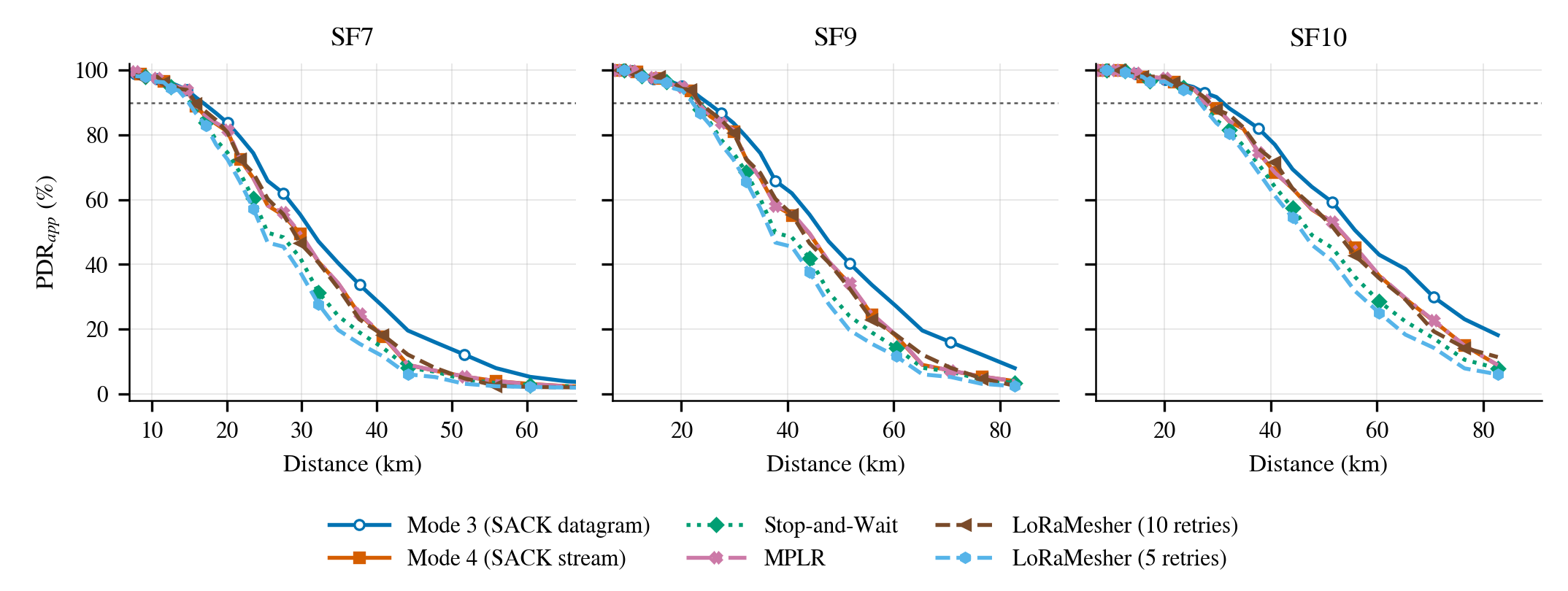 (a)
Rural
Propagation
Channel
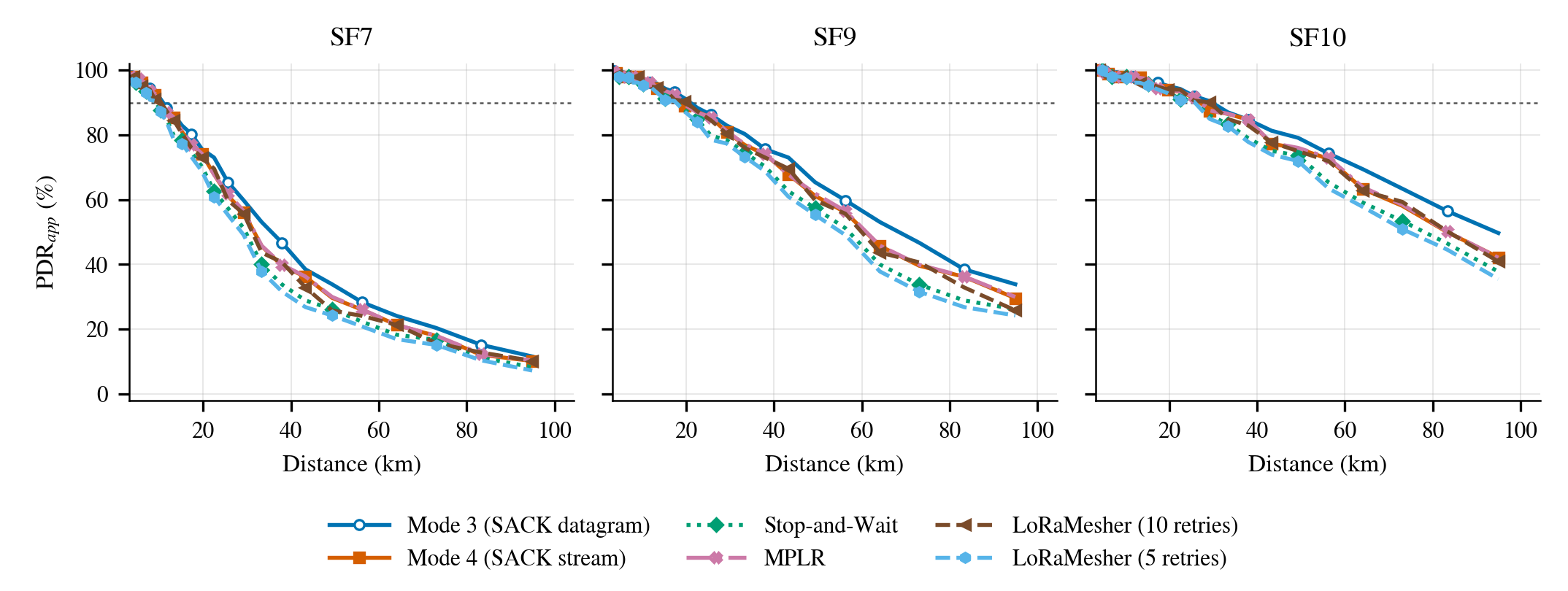 (b)
Water
Propagation
Channel
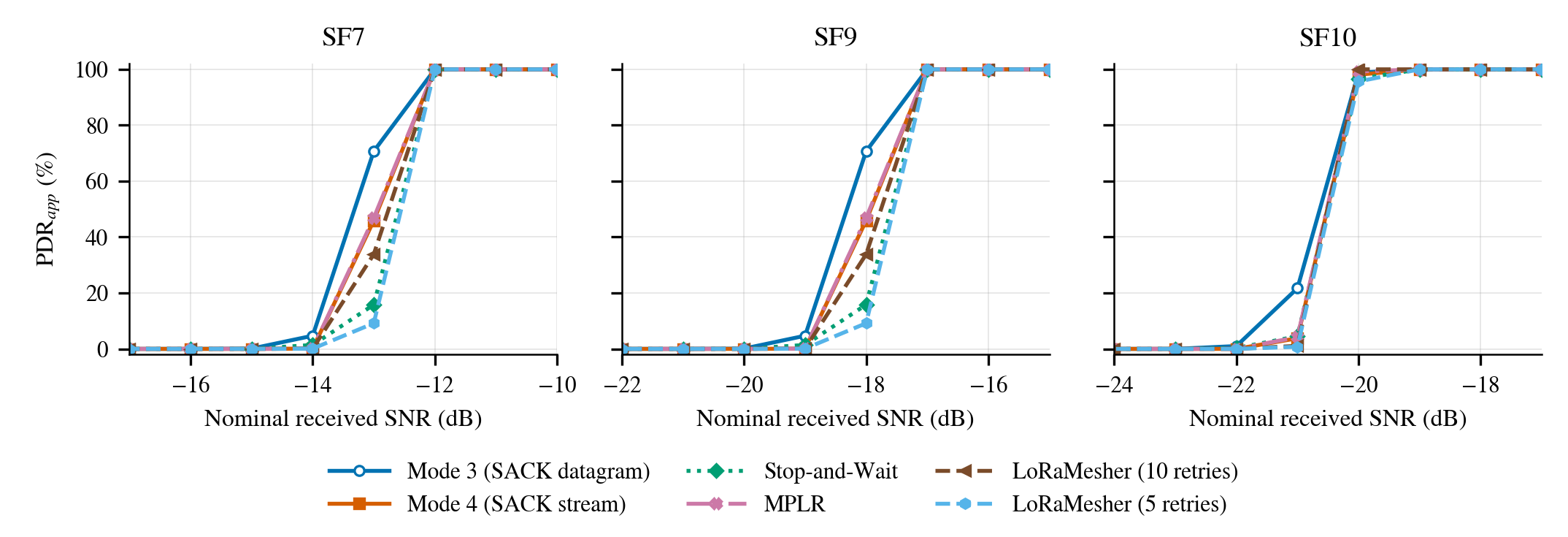 (a)
PDR
vs.
Nominal
SNR
in
Static
Channel
 (b)
Goodput
vs.
Nominal
SNR
in
Static
Channel
[1] T. Chen, D. Eager, and D. Makaroff, “Efficient image transmission using LoRa technology in agricultural monitoring IoT systems,” in 2019 IEEE International Conference on Internet of Things (iThings) and IEEE Green Computing and Communications (GreenCom) and IEEE Cyber, Physical and Social Computing (CPSCom) and IEEE Smart Data (SmartData), 2019, pp. 937–944.
[2] J. M. Solé, R. Pueyo Centelles, F. Freitag, R. Meseguer, and R. Baig Viñas, “Large and reliable data transfer service for LoRa mesh network applications,” Computer Communications, vol. 248, p. 108404, 2026.